When Sailor Moon Draws Mickey Mouse: The American Artists Bringing Hentai Home
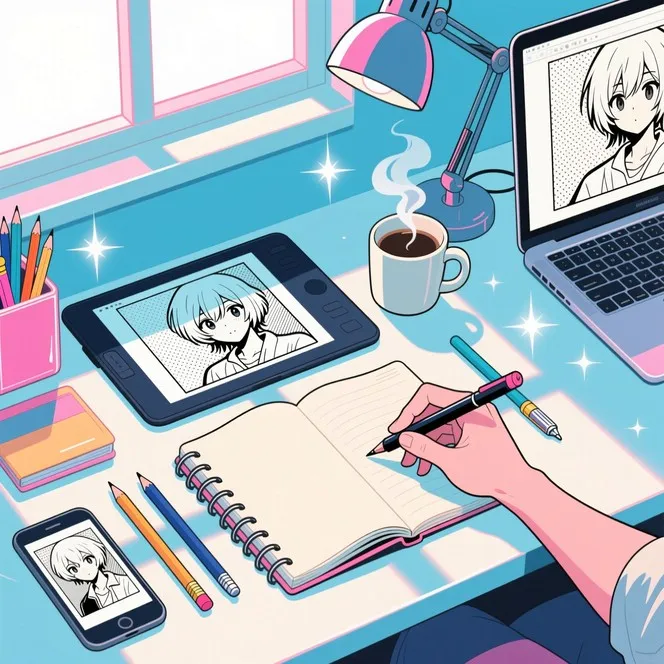
Photo: artist drawing digital illustration tablet anime style workspace, via images.stockcake.com
There's a moment that keeps happening in artist alleys from San Diego to Chicago. A fan walks up to a table, flips through a portfolio of work that is unmistakably, technically hentai — the linework, the shading, the particular way a blush is rendered — and finds Superman, Bubbles from the Powerpuff Girls, or a very flustered Bugs Bunny staring back.
Then they buy the print anyway.
The Reverse Import
For forty years, the flow of artistic technique went one direction: Japan borrowed what it liked from Disney, from mid-century American advertising art, from Sunday comics, and cooked it into something new. American fans grew up consuming the result, often without realizing how much of the visual DNA was ours in the first place.
The artists I spoke with for this piece describe what's happening now as the second half of the trade. They learned anatomy from studying decades of adult anime, learned color theory from Cel-shaded doujinshi, learned pacing and panel rhythm from manga. Now they're applying that vocabulary to characters who never left Topeka.
"It's not appropriation," one Los Angeles-based illustrator told me. "It's a homecoming. The style left, went to school, and came back with a degree."
Copyright's Grayest Zone
Let's be honest about the legal landscape, because the artists certainly are. Nobody's making original prints of the House of Mouse in explicit situations and expecting a license agreement. The entire scene operates in the same gray zone that fan art has always occupied — tolerated in small quantities, invisible at scale, and dependent on rights holders deciding that suing a convention table artist is worse PR than the art itself.
The hentai-style reinterpretation crowd adds one wrinkle: the work is often explicit enough that it can't be sold in mainstream artist alleys at all. It lives on Patreon, on private Discord servers, at adults-only conventions in hotel ballrooms off the Vegas strip. That exile from the mainstream, several artists argue, is actually protective. Small, scattered, and pseudonymous is a survivable posture. Viral and monetized is not.
The Comic Tradition Grows Up
Here's the argument that surprised me most, and I think it holds water: American cartooning finally has the technical maturity to pull this off.
The US comic tradition — the newspaper strip, the indie black-and-white boom, the superhero house style — was always built around a different set of priorities. Exaggeration over suggestion. Gag over atmosphere. The American adult comic of the '90s, when it existed at all, tended toward either crude underground scatology or stiff, airbrushed pinup work that borrowed its grammar from men's magazines, not from animation.
What hentai aesthetics offer is a complete system for drawing adult content that is still fundamentally cartoony. It never apologizes for being drawn. It treats exaggeration as a feature. And crucially, it built an entire visual language for depicting desire — the averted eyes, the trembling line, the economy of a single sweat drop — that American cartooning simply never developed, because there was no market structure to reward it.
Now there is. A generation of artists raised on both Saturday morning reruns and late-night imports sits down with both traditions in their hands, and the crossover work is getting genuinely good. Not transgressive-for-transgression's-sake good. Technically good. Composition, emotion, craft.
The Fans Are Already Here
The audience for this work is not what you'd expect, either. It's not purely the hardcore hentai collector. It's the animation industry dropout, the storyboard artist between gigs, the 34-year-old who grew up on Toonami and now has a disposable income and a private art collection. American fans have spent two decades being told their two interests — Western animation and adult anime — belonged in separate rooms. The crossover work just knocks down the wall between them.
And the reception, at least in the rooms where this art is allowed to exist, has been enthusiastic in a way that feels less like novelty and more like appetite. People commission it. People collect it. People argue about it in Discord servers at two in the morning with the same passion they bring to any other fandom fight.
What Happens Next
The honest answer is that nobody knows, because the whole scene exists just below the visibility line of the industries that could change it. If a major rights holder ever decided to make an example of someone, the climate could freeze overnight. If the current détente holds, the gray zone will keep producing work that's more ambitious than anything a licensed product could ever risk.
Either way, something real has happened. The style came home, it found students, and those students found an audience. American animation gave the world the vocabulary. Adult anime gave it the grammar. The artists redrawing our cartoons in the hentai style are just the first generation fluent enough in both to hold the conversation.
We'll be watching. Quietly, from the Republic.